
Web based e-accounting solution by offshore software development india
Access your accounts information anytime, anywhere with E - Accounting Solution. This solution does not need an internal book keeping or final accounts application. This solution provides you with the web based facility that is extremely accurate, with fast data processing. The solution can be used as internet as well as intranet application. By using the internet it can take accounting industry into the online age and beyond imagination. Our web based accounting solution gives you direct access and control over your accounts from your desktop.
Key Features of E - Accounting Software
» Anytime anywhere access
» Fast access quick result
» Relate multiple users and locations
» Secure data processing
» Minimize technology hassles
Major modules of E - Accounting Software
» Customer and Sales
» Suppliers and Purchases
» Banking
» Invoicing
» Nominal Ledger
» Financial module
» Reports
» Security and user management
» Configuration module
More Information: - (Financial Accounting System)
http://www.offshoresoftwaredevelopmentindia.com/online-accounting-fas-india/financial-accounting-system.htm
About OffshoreSoftwareDevelopmentIndia.com
Offshore Software Development India is a software solution provider based in Ahmedabad, India. We offer IT services and solutions in the areas of Web Designing, Web Developing, E-Accounting, E-Business, Enterprise Application Integration, On-site Consulting, Customized Application Development, Offshore software development and Outsourcing.
Visit this site: - http://www.offshoresoftwaredevelopmentindia.com
Offshore Software Development India
Maven Infosoft Pvt Ltd
D - 406, Shiromani Complex,
Near Nehrunagar cross road, Opp. Ocean Park,
S. M. Road, Satellite Road,
Ahmedabad - 380015
India.
Tel: +91-79-65457841
Tel: +91-79-26767840
Email: info@offshoresoftwaredevelopmentindia.com

|
| Subscribe to Software Outsourcing [ Hire Dedicated Group ] |
| Visit this group |
Saturday, December 8, 2007
Web based (E) Accounting Solution

Wednesday, December 5, 2007
Magento Commerce - Get ready for new Open Source E-Commerce solution
 After investing 5 years in osCommerce based E-Commerce solutions, Varien has launched preview version of it's own Open Source E-Commerce Solution - Magento.
As osCommerce is not much upgraded since long time, E-Commerce service providers are eagerly waiting for new solutions with more functionalities and features, Magento will have to pass through a difficult examination. At a first look at the website of Magento it seems that it would be better than any older E-Commerce solutions.
It is very hard to make users to switch from other products to your product. Because first question they would ask you is: "What's better in yours than the current?". Varien says something in answer of it on their Why Magento Page.
- No Constraints
Magento is much flexible so that you can create your online store exactly as your business model without any extra clutter or constricting design limits. - Completely Scalable
Magento is completely scalable. So with growing of your site, you can easily manage more resources. - Professional and Community Support
Magento offers professional reliable support, as well as the help of its passionate community. - Smooth Integration
You can create your customized store according to your business model in Magento with easier integration by saving your time and resources. - Cutting Edge Features
Magento provides many extra features like Produce Tagging, Multi-address Shipping, Product Comparison System etc. those are not yet provided by any other open source e-commerce solutions.
Let's wait for it's first Beta Release and examine it's power trying it our self.
Object Oriented Prgramming (OOP) without classes!!!
Nowadays, object oriented programming (OOP) is quickly taking place over the traditional procedure oriented programming (POP). Success of the modern programming languages like C# and Java is obviously because of OOPs Power.
As all the OOP languages use CLASS or similar data structures for Object Oriented Programming, we have considered that without a "CLASS", OOP is not possible.
With the same idea in my mind, I’d briefly gone through the code base of "Drupal" - One of the most popular open source content management system and framework built with PHP language. I often read and heard many praise about the power of Drupal, but after the first look at the code base, I amazed that Drupal doesn’t use a single Class in it’s code base! Whole Drupal code base is based on just functions. As PHP, with which programming language Drupal itself is built, is also implementing many powerful OPP features, I could not understand why Drupal is not using these features!
As I’d not seen the keyword 'class' in Drupal code base, I evaluated Drupal as non-OOP as many programmers do. And that was my mistake! Even though, Drupal doesn’t contain any class like data structure, it is still Object Oriented. I realized this fact after details study of Drupal.
Actually, the OOP concept is not based on uses of data structures like CLASS. It is based on the fundamentals of features like Objects, Abstraction, Encapsulation, Polymorphism, Inheritance etc. If these fundamental features are included in programming then it can be considered in OOP.
Drupal covers all these features without classes. I also realized that the power of Drupal is hardly depends on this programming structure only. The way, how the hook system has been implemented in Drupal would never been possible with the use of Classes.
See more details about how Drupal implements Object Oriented Programming (OOP) without using Classes, visit: http://api.drupal.org/api/HEAD/file/developer/topics/oop.html
Framework 3.0 Architecture
Framework 3.0 What is the Microsoft .NET Framework 3.0? The Microsoft .NET Framework 3.0 (formerly WinFX), is the new managed code programming model for Windows. It combines the power of the .NET Framework 2.0 with four new technologies: Windows Presentation Foundation (WPF) Windows Communication Foundation (WCF) Windows Workflow Foundation (WF), and Windows CardSpace (WCS, formerly "InfoCard"). Use the .NET Framework 3.0 today to build applications that have visually compelling user experiences, seamless communication across technology boundaries, the ability to support a wide range of business processes, and an easier way to manage your personal information online. This is the same great WinFX technology you know and love, now with a new name that identifies it for exactly what it is – the next version of Microsoft's development framework. Framework 3.0 Architecture: What is Workflow? In the business world, workflow is how an item is moved from one person to another through a process. That process is the business process, and it defines the steps necessary to complete a piece of work. Steps in the process can be required or optional. For example, a business process for a vacation request might be that the employee must provide some information, such as the dates requested, to his or her supervisor. Then, the employee's supervisor must determine if the employee has vacation time to use, and if the date or dates requested are available for vacation. A state-based workflow :waits on external entities to perform some action before moving to the next step. This example of workflow has a large amount of potential branching. Within a workflow, branching is when a decision needs to be made, such as when the supervisor must determine if the employee has enough vacation time to use, and if company policies related to staff size within a department will be met. In this case, two decisions need to be made: first, if the employee has vacation time to use, and second, if policies have been met. For each branch in a workflow, there must be at least two alternatives. You can't have a workflow just stop at a decision point. Sequential workflow : Another type of workflow is sequential. Sequential workflow is a workflow whose steps are performed one right after the other, but might include branching. In this case, sequential refers more to continuous operation, instead of the order in which actions are performed. The traditional concept of sequential in programming is without branching, but when related to workflow, sequential means continuous, instead of without branching. Steps in a Sequential workflow don't wait for an external entity to perform the next step. You can think of the Sequential workflow as close to continuous. There might be some external entity's action required to begin the flow, but once the flow is started, little if any external action is needed. Technology must be applied to a business process. For example, you might have a process that automatically updates a sales order as complete, and sends an e-mail notice to the customer and the sales person when a sales order is shipped. An external entity must start the process by saying that the sales order has shipped, but then some system would mark the sales order as complete, determine the customer's e-mail address, determine the sales person's e-mail address, and then send the e-mail. Once an external entity initiates the flow, the flow continues until an exception is encountered or the flow is completed. Introducing Windows Workflow Foundation (WWF): Windows Workflow Foundation (WF) is a technology that Microsoft has packaged with the .NET Framework for Microsoft Vista. WF is part of the programming model for Microsoft Vista, the next release of the Windows operating system. The new name for that programming model is WinFX, and it's a significant expansion of the Microsoft .NET Framework that was first released several years ago. Although WF is part of the WinFX programming model for Windows Vista, it can be run on clients that have Windows Server 2003 SP1, Windows XP SP2, Windows XP Home Edition, or Windows XP Media Center Edition. To develop workflow applications, you must be using Visual Studio 2005—any version except express. You can build workflow applications using VS2005 by adding the Visual Studio 2005 Extensions for Windows Workflow Foundation. One of the biggest IT topics today has to be the concept of Service-Oriented Architecture (SOA).Service-Oriented Architecture isn't new. You'd think that with the coverage it has received over the past few years that developers and "techy" individuals would understand it better, yet it ranks fairly high on the misunderstood-o-meter because its interpretation, implementation, and use is pretty loose due to the fairly vague definition. When you want to understand the meaning of something, you usually go to a place that defines it, such as a dictionary. In this case, we turn to the W3C to understand the definition of SOA. The W3C defines Service-Oriented Architecture as "A set of components which can be invoked and Whose interface descriptions can be discovered and published" As you sit and ponder this definition, it becomes quite apparent that this definition is fairly broad. It also becomes apparent why the Service-Oriented Architecture picture is somewhat fuzzy, because the definition leaves a lot of room for interpretation. ❑ How Windows Communication Foundation addresses the SOA needs Service-Oriented Architecture Principles: Streams of information have been flowing from Microsoft in the forms of articles and white papers Regarding its commitment to SOA and in this entire information one of the big areas constantly stressed are the principles behind service orientation: ❑ Explicit boundaries ❑ Autonomous services ❑ Policy-based compatibility ❑ Shared schemas and contracts Built on top of the 2.0 .NET Framework CLR (Common Language Runtime), the Windows Communication Foundation is a set of classes that allow developers to build service-oriented applications in their favorite .NET environment (VB.NET or C#). This section begins by taking a detailed look at the architecture of WCF and the components that make WCF what it is. Introduction: When .NET first appeared, it introduced a small avalanche of new technologies. There was a whole new way to write web applications (ASP.NET), a whole new way to connect to databases (ADO.NET), new typesafe languages (C# and VB .NET), and a managed runtime (the CLR). Not least among these new technologies is Windows Forms, a library of classes for building Windows applications. Although Windows Forms is a mature and full-featured toolkit, it's hardwired to essential bits of Windows plumbing that haven't changed much in the past ten years. Most significantly, Windows Forms relies on the Windows API to create the visual appearance of standard user interface elements such as buttons, text boxes, check boxes, and so on. As a result, these ingredients are essentially uncustomizable. For example, if you want to create a stylish glow button you need to create a custom control and paint every aspect of the button (in all its different states) using a lower-level drawing model. And don't even think about introducing animated effects such as spinning text, shimmering buttons, shrinking windows, or live previews because you'll have to paint every detail by hand! The Windows Presentation Foundation (WPF) changes all this by introducing a new model with entirely different plumbing. Although WPF includes the standard controls you're familiar with, it draws every text, border, and background fill itself. As a result, WPF can provide much more powerful features that let you alter the way any piece of screen content is rendered. Using these features, you can restyle common controls such as buttons, often without writing any code. Similarly, you can use transformation objects to rotate, stretch, scale, and skew anything in your user interface, and you can even use WPF's baked-in animation system to do it right before the user's eyes. The Internet continues to be increasingly valuable, and yet also faces significant challenges. Online identity theft, fraud, and privacy concerns are rising. Users must track a growing number of accounts and passwords. This burden results in "password fatigue," and that results in insecure practices, such as reusing the same account names and passwords at many sites. Many of these problems are rooted in the lack of a widely adopted identity solution for the Internet. CardSpace is Microsoft's implementation of an Identity Metasystem that enables users to choose from a portfolio of identities that belong to them and use them in contexts where they are accepted, independent of the underlying identity systems where the identities originate and are used. But as the value of what people do online have increased, the Internet itself has become more complex and dangerous. Online identity theft, fraud, and privacy concerns are on the rise. And increasingly sophisticated practices such as "phishing" are invented. In response, a multitude of systems designed to protect identity have been devised. The diversity results in the aforementioned password fatigue and unsafe practices. The root of these problems is that the Internet was designed without a system of digital identity in mind. In efforts to address this deficiency, numerous digital identity systems have been introduced, each with its own strengths and weaknesses. But no single system meets the requirements of every digital identity scenario. The reality is that many different identity systems are in use today, with still more being invented. The result is an inconsistent patchwork of improvised solutions at every Web site, rendering the system as a whole fragile, and constraining the fuller realization of the promise of e-commerce.
Thursday, November 15, 2007
Google Adsense Profits Article
Internet Marketing - What Do You Think of the 'Adsense is Dead' Debate?
Are you here: This is a hard-ranging debate started by click flippers that are licking their chops over Google Adsense slaps.
Or here: Adsense is alive, and for white hat marketers, Adsense revenue is way up, and will continue to climb. Adsense is only dead for black hat marketers who disrespect Google Adsense and the financial opportunity provided by Google.
I think everyone that has been able to keep out of the emotional fray recognizes that the Adsense is Dead campaign was strictly created to sell an over priced course on click flipping.
But what is the truth? Google Adsense revenues seem to be up. But bid prices seem to me to be down. Does this mean that a larger number of sites are now hosting Adsense and therefore the average operator revenue is down while Google profits are up?
Can new Adsense templates (like the one to be released today) make up for the stress of the death of Adsense, or is this just another ploy to put money in the pockets of another long-term marketer?
My personal opinion - Google will find a way to ban the new Adsense templates as soon as they become profitable.
My solution to the internet marketer: Stop relying on Google Adsense for revenue, allow bid prices to drop, and use Google Adwords to drive high-profit traffic to solid, sales driven web sites.
My solution involves driving subscriber traffic to my high profit information sites that convert to big dollars for me-- and I don t give Google, click flippers or Adsense templates my dollar.
More Information / Source
Wednesday, November 14, 2007
How To Choose an SEO Agency and Why
When you're scoping out a Web site design project, you expect prices to fluctuate from provider to provider. You expect one company's talents to be greater than another's. You expect to pay for added functionality.
When pricing SEO (define) services, many companies have a hard time getting a handle on what they should pay. Why? It's not easy to understant the numerous tactics and strategies that go into an SEO project.
If you're shopping around for SEO services, compare companies. That's just common sense. You'd be surprised, though, how few companies do it. Comparing companies ensures you're not just getting the best price, but the best value. That's what you do with most big ticket purchases.
Scope Out the SEO Project
When shopping for Web site redesign, you'll likely set up an internal discovery meeting to determine the scope of the site redesign project. This process usually involves countless hours with those responsible for the brand -- designers, the marketing team, and many other "decision makers" within the organization.
Unfortunately, most SEO projects don't receive near the time and attention afforded to Web design projects. In many cases, that's a colossal mistake.
Without the due diligence on your Web site's SEO challenges, it's almost impossible to understand the scope of work necessary to launch a successful SEO campaign. Do you have JavaScript navigation? Does your site content reside within images or frames? Do you lack for content? Will you need to write many pages of copy, add them to the site architecture, and build out pages? Does your site have others linking to yours? Is your internal link structure sufficient?
Once you answer some of these questions, ask yourself if you have the resources -- internally -- to do this work. Or will you need an SEO company to handle these tasks?
What's the Competitive Landscape?
With SEO, the competitive landscape is everything. You have to look at not only who your known competition is (those companies you compete with on a daily basis), but also who your keyword competitors are. In other words, what companies are ranking for the keywords you want your company to rank for?
You also must take into account the degree of competitiveness for the keywords you want to rank for. Are you trying to rank for "home loans" or "Dallas home loans"? Big difference.
For those trying to be found for highly competitive keywords, the timeline to rankings and/or significant traffic increases can be a daunting and time-consuming task. As with any service-oriented company, time is money. So, if the scope of the work determines the highly competitive keywords are the goal, then you can expect to pay more money.
The more competitive the keywords, the more content you may need to write. That means more pages to add to your Web site and more assistance with link generation.
What Are You Spending on PPC?
Funny thing. So many companies spend thousands upon thousands of dollars on PPC (define), because they know they only pay when someone clicks. Well, that's great, but there's no doubt that a well developed SEO campaign can do better, even if you measure it on a PPC basis.
For example, at Vizion Interactive, we have a client that spends less than $10,000 per month on SEO and also spends approximately $100,000 per month on PPC. The traffic they receive from SEO is valued at approximately $2 million per month. If they'd acquired this traffic on a PPC basis, that's what they'd be paying. For the $100,000 they spend on PPC, they get $100,000 worth of traffic.
Do you see what I mean?
So, for all of you companies out there who are considering SEO, I'm here to tell you: find a reputable provider and go for it.
Source
Saturday, November 3, 2007
Framework 3.0
Framework 3.0
What is the Microsoft .NET Framework 3.0?
The Microsoft .NET Framework 3.0 (formerly WinFX), is the new managed code programming model for Windows. It combines the power of the .NET Framework 2.0 with four new technologies:
- Windows Presentation Foundation (WPF)
Windows Communication Foundation (WCF)
Windows Workflow Foundation (WF), and
Windows CardSpace (WCS, formerly "InfoCard").
Use the .NET Framework 3.0 today to build applications that have visually compelling user experiences, seamless communication across technology boundaries, the ability to support a wide range of business processes, and an easier way to manage your personal information online. This is the same great WinFX technology you know and love, now with a new name that identifies it for exactly what it is – the next version of Microsoft's development framework.
This is Some Informations More Information
Go
To
Saturday, October 20, 2007
Get 10,000 “unique” visitors a month!
Get 10,000 unique visitors to your website - now
Are you using “social Media” sites correctly?
For the last 3 months I’ve gotten 10,000 plus “unique” visitors to my small site using “Social Media tips”
Can you “DIGG” it, can you - Digg it ????
One of my all time favorite movies is “Warriors”, it’s about a gang that is framed for the murder of an influential gang leader [ Cirus ] who only wanted to unite all the gangs of NY - sort of like organized crime today. It’s a wonderful movie to watch.
But I bring it up only because I am curious if you are using “DIGG” and the other like kind social media’s?If used correctly you can build your ranking, your website’s traffic and even make money - Can you “DIGG” it.. can you digg it…
While people are talking about little things like : is myspace losing to Facebook? Or things like: Will Yahoo buy XYZ company? People like you and me are losing the opportunity to make good use of social media sites like “Myspace”, “you tube”, “face book”, even “Blink”….I want you to think about it, a good catchy title and good content can get you hundreds if not thousands of visitors to your site - In one day…. I did a small experiment, just to test it out. I used “Digg” and linked a page from one of my sites [ can not divulge source ] and with a good catchy title had 3,560 visitors go to my site in one day.
You say so what, others do it all the time….. But for a new site that has yet to be index on any search engine. No ranking, no SEO, nothing - just - DIGG………. ????
No this is not a replacement for good old fashion “SEO” or providing good content. But it can help a struggling beginner and a small website compete with the big boys.
Tuesday, October 9, 2007
Offshore Software Development India – Php and .Net Development India
Our Google Group Name and Link
- Offshore Software Development India – Php and .Net Development India http://groups.google.co.in/group/software-company-india
5 Essential Joomla Extensions
Standard Joomla installation comes with some very powerful tools but here are some additional Joomla extensions recommended for every business web site:
1. Easily insert images or video and create file links with professional JCE EDITOR . JCE Image Manager is especially good for resizing and managing your image library.
2. Allow search engines to effectively scan your web site for any changes and updates with JOOMAP . Joomap is a sitemap component for Joomla that shows the normal Menu Structure, Content Categories and Sections in a hierarchical list.
3. Perform a daily backup of your web site database and email it to your preferred email address with JOMBACKUP PLUGIN . It provides a piece of mind and is recommended for databases smaller than 2MB.
4. Edit, delete, copy, rename, archive and unpack files or directories directly on your server with JOOMLAXPLORER . It's highly recommended for shared hosting environments where you do not have a complete server access.
5. Stay in touch with your visitors with LETTERMAN newsletter component. It is good for providing a simple newsletter feature on your site, without multiple lists. Users can subscribe/unsubscribe themselves on your web site or you can import multiple subscribers using a CSV file. Copies of previous newsletters can be easily published to your web site ! Check with your server host if there are any restrictions on a number of emails you can send out.
More Information
Intel Launches Digg Clone For Software

The site is said to focus solely on business ideas, and is designed to tap into the opinions of the wider developer and entrepreneur community.
According to a report at Venture Beat, the site cost around $40,000 to develop and has been tested internally, with Intel soliciting views from its employees about the hottest software companies.
Like any good Digg clone, it appears that it hasn’t taken too long for it to be gamed, with the top result at the time of writing being for the Open Source CMS Joomla. Even if it isn’t gamed for advantage by some, it’s a little strange that Intel wants to use the site to find “the next Google” whilst offering it to the public; after all if the model does identify the next Google, wouldn’t everybody see the result and have an opportunity to jump in before Intel does?

More Information: - http://www.techcrunch.com/2007/10/08/intel-launches-digg-clone-for-software/
Saturday, September 29, 2007
AJAX and the Mobile Web
A workshop will allow leading vendors to address the mobile Web and the need for more applications.
With smart phones becoming more prevalent among users and delivering greater capability than ever before, where are the applications to take advantage of all this power?
That is a key question the OpenAjax Alliance and the World Wide Web Consortium, or the W3C, hope to answer at a workshop they are jointly holding on Sept. 28.
The two organizations are coming together to encourage discussion about—and build a more complete picture of—the future of interactive mobile Web applications, organizers of the event said.
The workshop will be at Microsoft's campus in Mountain View, Calif. The timing for the event coincides with the AJAX World conference, in Santa Clara, Calif., which ended Sept. 26, and a membership meeting of the OpenAjax Alliance Sept. 27.
Meanwhile, organizers of the joint workshop said participants will explore user and industry-use cases and challenges around AJAX (Asynchronous JavaScript and XML) applications on mobile devices and what types of applications are likely to succeed in mobile environments. Participants also will look for ways to identify the unique aspects of the mobile Web experience, and how they affect AJAX application development. In addition, they will discuss the applicability of standardization activities in this developing area.
PointerRead here about Microsoft joining the OpenAjax Alliance.
Jon Ferraiolo, Web architect in the Emerging Technologies division of IBM's Software Group, and Daniel Appelquist, a senior technology strategist at Vodafone, are chairing the workshop.
Ferraiolo, who is also the director of the OpenAjax Alliance, said the question of the Web on mobile devices is complex. There are whole conferences on the subject of the mobile Web. For example, on Oct 15 Vodafone is sponsoring a day of speakers on the subject, he said. At the joint OpenAjax Alliance/W3C event, there will be nearly 40 position papers submitted, each reflecting the points of view of companies or individuals in the industry, Ferraiolo said.
"What I am hoping is that this workshop will provide a broad industry perspective on things having to do with the term 'mobile AJAX' and help inform two industry groups [W3C and OpenAjax Alliance] so that we can start new initiatives or modify existing initiatives to help the industry be successful with HTML and AJAX technologies on mobile devices," Ferraiolo told eWEEK.
Workshop participants are also expected not only to look at the need for more applications, but also at easing the job of developers who will be building mobile Web applications.
Dion Almaer, an engineer at Google and co-founder of Ajazian.com, said that there are "millions of developers that know how to hack out some Web stuff. On the other hand, building mobile apps in Java with MIDP [Mobile Information Device Profile] or the like is insanely difficult. So, if you can let people develop apps for the phone in a simple way—such as AJAX—then you get all of the developers."
In terms of what IBM, of Armonk, N.Y., brings to the table, Ferraiolo said that "probably the most important is that we are a proxy for our enterprise customers who want to extend their applications and services onto mobile devices."
The W3C has multiple mobile initiatives already in place, including MWI (Mobile Web Initiative ).
James Pratt, senior product manager on the Windows Developer Experience Team at Microsoft, said the Redmond, Wash., company is looking to provide developers with choices and flexibility for bringing their applications to mobile devices, whether via Mobile AJAX, Silverlight for Mobile Devices, the .Net Compact Framework, or native applications.
Workshop participants who have submitted position papers include AOL, the Dojo Foundation, Google, Harvard Medical School, IBM, ICESoft, Microsoft, Motorola, NEC, Nexaweb, Nokia, DoCoMo, Research in Motion, SAP, Sprint, Sun Microsystems and Yahoo.
In a position paper for the workshop, Alan Tai, lead engineer on the mobile search product AOL launched into beta in August, called for more application development.
Tai wrote that until "recently, smart phones were a high-end niche device for the business professional: expensive and mostly relegated to e-mail. Some devices can attempt to browse the 'full' Web, but the screens are tiny, layouts squashed, and scripting support (much less AJAX) lacking or nonexistent. As a result, smart phone users end up going back to the same static and boring XHTML-MP [Extensible HyperText Markup Language Mobile Profile] formatted sites that simple WAP [Wireless Application Protocol] phone users went to. Mobile website designers could create a template for smart phones, but why bother if the segment was too small and fragmented and speeds too slow for rich media over mobile?"
That has changed over the past two years, Tai said later in the paper. "Most smart phones, notably Windows Mobile and Symbian S60, support JavaScript and Ajax over speedy 3G networks."
Tai concluded that the demand for mobile Web development will only grow, with smart phones powerful enough to support client-side scripting and AJAX and at the same time becoming cheap enough to drive widespread adoption.
"To satisfy this increasing demand for rich Web applications on smart phones and kick off the innovation, AOL just released a mobile search engine that uses DHTML tabs to make navigation faster and more intuitive," he said. "In the mobile search arena, we will see more DHTML and AJAX used for on-demand loading of results and interactive widgets, among many other uses."
Source by eweek.com
Thursday, September 20, 2007
Google Adsense for Mobile

Google Adsense have just launched AdSense for mobile, which can help you expand your online content to new platforms. If you have a website optimized for mobile browsers, or are interested in creating one, you can start monetizing your mobile site by accessing a growing number of our mobile advertisers.
When you add the new AdSense for mobile code to your site, we'll display relevant ads using the same targeting technology that you are familiar with for existing AdSense products.
To get started:
1) Sign in to your account.
2) Select the AdSense Setup tab and click on AdSense for mobile.
3) Follow the instructions to customize your ad unit for AdSense for mobile.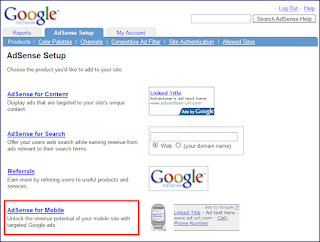
For the time being, publishers are welcome to add one ad unit to any mobile website that complies with our program policies. For more information, including technical requirements, visit the AdSense Help Center.
Multimedia Flash
animation and video may look cool to site visitors, but search engines cannot read or index the content embedded within multimedia objects. That is not to say that you shouldn’t use multimedia where appropriate, but be aware that it is not search engine-friendly. Inserting Flash components as individual page elements (amongst HTML) to achieve the effects you seek is a much better option than building entire pages in Flash if you want search engines to find the pages.
Measuring Success
So, how do you assess the fruits of your labor when it comes to SEO? One of the primary ways to gauge performance is to treat the SEO process as an experiment with measurable beforeand- after results.
Before you begin optimizing your pages, note the rank of the pages you are optimizing for your target terms in given search engines. If you know the rank of a given page before you begin SEO, you can then use that rank as a baseline to compare against your post-SEO rankings once the search engines have re-indexed your pages. Similarly, you can also measure your pre-optimization and post-optimization site statistics to see if there is a noticeable improvement. Other key indicators you can track include email inquiries, sales orders, incoming calls, newsletter subscriptions, membership applications or anything else that would be the logical result of increased public exposure.
It is important to remember that effective search engine optimization is not about “tricking” the search engines into ranking your site favorably. Rather, SEO is a research process designed to deliver relevant information to the people seeking that information. The better you are able to optimize your page content to suit the needs of your target visitors, the greater success you will have in not only attracting visitors to your site, but making sure that they are happy with what they find once they get there.
Source by creeper-seo.com
Thursday, September 13, 2007
Themes Development for open source solutions like Drupal, Joomla, Wordpress, PhpBB, Zend cart, Oscommerce
It corporate and professional Themes Development or all the versions of Drupal and for other open source solutions
An enhanced experience of the drupal development leads offshore software development
For more details:
Offshore Software Development India
406, Shiromani complex
Nr Nehrunagar cross road
Nehrunagar
Ahmedabad 380015
Tel: +91-79-65457841
Fax: +91-79-40067841
Email: info@offshoresoftwaredevelopmentindia.com
Thursday, September 6, 2007
P and P launches regular Joomla! workshops in Cape Town, Johannesburg
Alongside P and P's already established PR workshops, and the demand for training on the open source CMS (Content Management System) platform, P and P has decided to deliver regular training workshops for users and administrators of Joomla!.
Max Pichulik, Director of P and P Content says, “We have seen a massive uptake in Joomla! designed websites, and an increased demand for training on the system. These workshops fit our business structure quite succinctly, as a greater portion of our income is generated from maintaining the content on Joomla! developed web platforms.”
The End User workshop is a basic one day training module, designed for new users whose primary role is to update sections of content to their website.
This course offers a series of 'how tos', from editing content using various WYSIWYG (What You See Is What You Get) editors, loading media and inserting it into content, creating image galleries and events to attract visitors. Crucial tips for users in harnessing the power of collaboration and search engine ranking are also discussed.
The Administrator workshop focusses on intermediate principles of installing your own Joomla! website, including extended features such as newsletter production, discussion forum implementation and the management of user directories.
This workshop includes the following topics: setting up a stand alone server for testing offline, populating transfer content from existing websites and other documents, installing templates, installing extensions (modules, components and mambots), backing up your Joomla! website and promoting your newly developed website to your market.
There will also be tips offered on how to protect your website against hackers and discussion on communications' strategies to sustain site interaction amongst colleagues and site members. An additional feature will be an introduction to Google applications.
The End User workshops will be held in Cape Town on Tuesday 11th September and Johannesburg on Thursday 13th September from 9h00 to 15h00 at a cost of R1600 (excl VAT) per delegate per day. (maximum 10 delegates)
The Administrator workshops will also be held in both cities, in Cape Town on Wednesday, 12th September and in Johannesburg on Friday, 14th of September at a cost of R2600 (excl VAT) per delegate per day.
The venue in Cape Town is iKhaya Lodge, City Bowl and The Peech in Melrose, Johannesburg. (venue is subject to change).
For more information, please contact Max Pichulik on 011 883 5806 or email max@pandp.co.za
A Google Apps Near You: Wikis - Coming Soon

Google said in July that it would be adding JotSpot to Google Apps, so this doesn't come as much of a surprise. The Google Operating System blog speculates that the launch will be timed with an announcement at this weekend's Office 2.0 event in San Francisco.
Last week, Richard MacManus wrote that the core products of a web office suite, are email, calendar, word processing, spreadsheets and presentation. Google, which this year acquired two companies working on presentation apps, will soon offer a suite that has all of those components. By adding wiki support to Google Apps, the company will be extending their web office with a product that could only be delivered on the web (remember, Richard's web office definition said that an online office package must extend "the functionality of desktop office suites ... by using Web Native features.")
Certainly Google Apps is not as comprehensive as Zoho's suite, but adding wikis and presentations will put it on firm footing in the web office wars and extends it into areas that Microsoft Office does not tread.
Source by readwriteweb.com
Saturday, September 1, 2007
One-way links, reciprocal links, three-way-links. What's best?
There are a lot of rumors about one-way links, reciprocal links and three-way links on the Internet. Which of these links work best for your business and which links do you need to get higher search engine rankings?
What are one-way links?
A one way link is a simple link from one website to the other. For example, if you link to http://finance.yahoo.com/ and that page doesn't link back to your website then it's a one-way link from your site to their site.
What are reciprocal links?
A link is a reciprocal link if you link to a website and that website links back to your website. You send visitors to the other site and the other website sends visitors back to you.
That makes sense because all visitors leave a website sooner or later. You can send your visitors back to search engines or you can send them to affiliates websites that send you traffic in return.
What are three-way links?
Some webmasters believe that reciprocal links don't help web pages to get higher search engine rankings. That's why they invented three way links: Website A links to website B, website B links to website C, website C links to website A.
Which links will help you to get higher search engine rankings?
Good inbound links will help you to get higher search engine rankings. None of the link types above is worth more than the other.
It's important that the links to your website are from related sites and on-topic. If a reciprocal link is on a low quality page with links to every Tom, Dick and Harry then it won't count much. However, that's also true if the same page carries a one-way link or a three-way link.
It doesn't matter if a link is one-way, reciprocal or three-way. It does matter if a link is on a related website. Links from high quality websites will help your rankings, links from garbage sites won't.
If you want to improve your search engine rankings, try to get links from web pages that have something to do with your site.
Source by free-seo-news.com
How your competitors can sabotage your website rankings
High rankings on search engines can help you to get a lot of customers. If your website has high rankings on Google for a good keyword then your website will get a lot of attention.
Your competitors also know that and and some of them might not use ethical business practices. There are some things that your competitors might do to sabotage your search engine rankings:
1. Your competitors might create spam under your name
All major search engines use links to calculate the ranking of web pages. It's not only the number of links that counts but also the quality.
Your competitor might add your website to several spam linking schemes to hurt your site.
In addition, your competitor might use your website URL for spamming in online forums, social network sites and blog comments. Although it's not you who is spamming the websites, it will be hard to prove that you're innocent and social network sites might ban your website (which will have a negative effect on the link structure of your site).
2. Your competitors might peach on you
Did you buy links on other websites to improve your search engine rankings? Google doesn't like that at all. If your competitor finds out that you use paid links he might tell Google and your rankings might drop.
The same can happen if you use any unethical SEO method on your website (hidden text, cloaking, etc.). If your competitor finds out and informs Google then it's likely that it will affect your search engine rankings.
3. Your competitor might send a copyright complaint
If a search engine has been notified about a copyright infringement on your website then the search engine must remove the page from its index for 10 days. If your competitor files a copyright complaint against you then your website can be temporarily removed from the search results.
4. Your competitor might create duplicate content
Search engines don't like duplicate content. If more than one web page has the same content then search engines will pick one page and drop the rest.
If your competitor creates duplicates of your web page content then these duplicates might get better rankings than your own site. Of course, this can cause legal problems for the person who duplicates the content (as all methods mentioned in this article).
You cannot avoid that unethical competitors spam other sites with your name but you can avoid being banned for using spam techniques on your web pages. Only use ethical search engine optimization methods to get high rankings on Google and other major search engines.
Source by free-seo-news.com
Wednesday, August 29, 2007
Joomla! Developer Network
The Joomla! Developer Network is a one stop shop for content and resources specific to developing for the Joomla! content management system. Whether you are looking for code samples, technical overviews, documentation, core team updates or any other information you may need on Joomla! development the developer network is here to help.
With the JDN we strive to provide you with a clear road map to understanding and working with the Joomla! API.
Third party developers have been asking for more transparency and we have been listening! Most of the ideas which are being implemented to build this site have come from them and we expect that the JDN will become a creativity and networking magnet.
Who is it for?The information on this site is not for everyone. If you are looking for information for using or administering a Joomla! website then you should consult the user documentation at http://help.joomla.org. But if you are interested in developing custom extensions this site will be an essential resource throughout your development process.
Does it cost anything?
Just like all good open source projects, the Joomla! code and all of the resources found in the JDN are free and open. No fees, no cliques, no confusion.
What can you find on the JDN?
http://dev.joomla.org/


 Offers Development Services For