
A workshop will allow leading vendors to address the mobile Web and the need for more applications.
With smart phones becoming more prevalent among users and delivering greater capability than ever before, where are the applications to take advantage of all this power?
That is a key question the OpenAjax Alliance and the World Wide Web Consortium, or the W3C, hope to answer at a workshop they are jointly holding on Sept. 28.
The two organizations are coming together to encourage discussion about—and build a more complete picture of—the future of interactive mobile Web applications, organizers of the event said.
The workshop will be at Microsoft's campus in Mountain View, Calif. The timing for the event coincides with the AJAX World conference, in Santa Clara, Calif., which ended Sept. 26, and a membership meeting of the OpenAjax Alliance Sept. 27.
Meanwhile, organizers of the joint workshop said participants will explore user and industry-use cases and challenges around AJAX (Asynchronous JavaScript and XML) applications on mobile devices and what types of applications are likely to succeed in mobile environments. Participants also will look for ways to identify the unique aspects of the mobile Web experience, and how they affect AJAX application development. In addition, they will discuss the applicability of standardization activities in this developing area.
PointerRead here about Microsoft joining the OpenAjax Alliance.
Jon Ferraiolo, Web architect in the Emerging Technologies division of IBM's Software Group, and Daniel Appelquist, a senior technology strategist at Vodafone, are chairing the workshop.
Ferraiolo, who is also the director of the OpenAjax Alliance, said the question of the Web on mobile devices is complex. There are whole conferences on the subject of the mobile Web. For example, on Oct 15 Vodafone is sponsoring a day of speakers on the subject, he said. At the joint OpenAjax Alliance/W3C event, there will be nearly 40 position papers submitted, each reflecting the points of view of companies or individuals in the industry, Ferraiolo said.
"What I am hoping is that this workshop will provide a broad industry perspective on things having to do with the term 'mobile AJAX' and help inform two industry groups [W3C and OpenAjax Alliance] so that we can start new initiatives or modify existing initiatives to help the industry be successful with HTML and AJAX technologies on mobile devices," Ferraiolo told eWEEK.
Workshop participants are also expected not only to look at the need for more applications, but also at easing the job of developers who will be building mobile Web applications.
Dion Almaer, an engineer at Google and co-founder of Ajazian.com, said that there are "millions of developers that know how to hack out some Web stuff. On the other hand, building mobile apps in Java with MIDP [Mobile Information Device Profile] or the like is insanely difficult. So, if you can let people develop apps for the phone in a simple way—such as AJAX—then you get all of the developers."
In terms of what IBM, of Armonk, N.Y., brings to the table, Ferraiolo said that "probably the most important is that we are a proxy for our enterprise customers who want to extend their applications and services onto mobile devices."
The W3C has multiple mobile initiatives already in place, including MWI (Mobile Web Initiative ).
James Pratt, senior product manager on the Windows Developer Experience Team at Microsoft, said the Redmond, Wash., company is looking to provide developers with choices and flexibility for bringing their applications to mobile devices, whether via Mobile AJAX, Silverlight for Mobile Devices, the .Net Compact Framework, or native applications.
Workshop participants who have submitted position papers include AOL, the Dojo Foundation, Google, Harvard Medical School, IBM, ICESoft, Microsoft, Motorola, NEC, Nexaweb, Nokia, DoCoMo, Research in Motion, SAP, Sprint, Sun Microsystems and Yahoo.
In a position paper for the workshop, Alan Tai, lead engineer on the mobile search product AOL launched into beta in August, called for more application development.
Tai wrote that until "recently, smart phones were a high-end niche device for the business professional: expensive and mostly relegated to e-mail. Some devices can attempt to browse the 'full' Web, but the screens are tiny, layouts squashed, and scripting support (much less AJAX) lacking or nonexistent. As a result, smart phone users end up going back to the same static and boring XHTML-MP [Extensible HyperText Markup Language Mobile Profile] formatted sites that simple WAP [Wireless Application Protocol] phone users went to. Mobile website designers could create a template for smart phones, but why bother if the segment was too small and fragmented and speeds too slow for rich media over mobile?"
That has changed over the past two years, Tai said later in the paper. "Most smart phones, notably Windows Mobile and Symbian S60, support JavaScript and Ajax over speedy 3G networks."
Tai concluded that the demand for mobile Web development will only grow, with smart phones powerful enough to support client-side scripting and AJAX and at the same time becoming cheap enough to drive widespread adoption.
"To satisfy this increasing demand for rich Web applications on smart phones and kick off the innovation, AOL just released a mobile search engine that uses DHTML tabs to make navigation faster and more intuitive," he said. "In the mobile search arena, we will see more DHTML and AJAX used for on-demand loading of results and interactive widgets, among many other uses."
Source by eweek.com

|
| Subscribe to Software Outsourcing [ Hire Dedicated Group ] |
| Visit this group |
Saturday, September 29, 2007
AJAX and the Mobile Web

Thursday, September 20, 2007
Google Adsense for Mobile

Google Adsense have just launched AdSense for mobile, which can help you expand your online content to new platforms. If you have a website optimized for mobile browsers, or are interested in creating one, you can start monetizing your mobile site by accessing a growing number of our mobile advertisers.
When you add the new AdSense for mobile code to your site, we'll display relevant ads using the same targeting technology that you are familiar with for existing AdSense products.
To get started:
1) Sign in to your account.
2) Select the AdSense Setup tab and click on AdSense for mobile.
3) Follow the instructions to customize your ad unit for AdSense for mobile.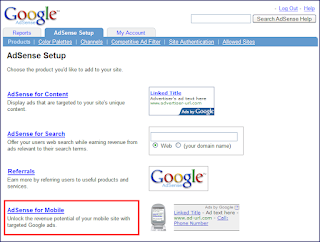
For the time being, publishers are welcome to add one ad unit to any mobile website that complies with our program policies. For more information, including technical requirements, visit the AdSense Help Center.
Multimedia Flash
animation and video may look cool to site visitors, but search engines cannot read or index the content embedded within multimedia objects. That is not to say that you shouldn’t use multimedia where appropriate, but be aware that it is not search engine-friendly. Inserting Flash components as individual page elements (amongst HTML) to achieve the effects you seek is a much better option than building entire pages in Flash if you want search engines to find the pages.
Measuring Success
So, how do you assess the fruits of your labor when it comes to SEO? One of the primary ways to gauge performance is to treat the SEO process as an experiment with measurable beforeand- after results.
Before you begin optimizing your pages, note the rank of the pages you are optimizing for your target terms in given search engines. If you know the rank of a given page before you begin SEO, you can then use that rank as a baseline to compare against your post-SEO rankings once the search engines have re-indexed your pages. Similarly, you can also measure your pre-optimization and post-optimization site statistics to see if there is a noticeable improvement. Other key indicators you can track include email inquiries, sales orders, incoming calls, newsletter subscriptions, membership applications or anything else that would be the logical result of increased public exposure.
It is important to remember that effective search engine optimization is not about “tricking” the search engines into ranking your site favorably. Rather, SEO is a research process designed to deliver relevant information to the people seeking that information. The better you are able to optimize your page content to suit the needs of your target visitors, the greater success you will have in not only attracting visitors to your site, but making sure that they are happy with what they find once they get there.
Source by creeper-seo.com
Thursday, September 13, 2007
Themes Development for open source solutions like Drupal, Joomla, Wordpress, PhpBB, Zend cart, Oscommerce
It corporate and professional Themes Development or all the versions of Drupal and for other open source solutions
An enhanced experience of the drupal development leads offshore software development
For more details:
Offshore Software Development India
406, Shiromani complex
Nr Nehrunagar cross road
Nehrunagar
Ahmedabad 380015
Tel: +91-79-65457841
Fax: +91-79-40067841
Email: info@offshoresoftwaredevelopmentindia.com
Thursday, September 6, 2007
P and P launches regular Joomla! workshops in Cape Town, Johannesburg
Alongside P and P's already established PR workshops, and the demand for training on the open source CMS (Content Management System) platform, P and P has decided to deliver regular training workshops for users and administrators of Joomla!.
Max Pichulik, Director of P and P Content says, “We have seen a massive uptake in Joomla! designed websites, and an increased demand for training on the system. These workshops fit our business structure quite succinctly, as a greater portion of our income is generated from maintaining the content on Joomla! developed web platforms.”
The End User workshop is a basic one day training module, designed for new users whose primary role is to update sections of content to their website.
This course offers a series of 'how tos', from editing content using various WYSIWYG (What You See Is What You Get) editors, loading media and inserting it into content, creating image galleries and events to attract visitors. Crucial tips for users in harnessing the power of collaboration and search engine ranking are also discussed.
The Administrator workshop focusses on intermediate principles of installing your own Joomla! website, including extended features such as newsletter production, discussion forum implementation and the management of user directories.
This workshop includes the following topics: setting up a stand alone server for testing offline, populating transfer content from existing websites and other documents, installing templates, installing extensions (modules, components and mambots), backing up your Joomla! website and promoting your newly developed website to your market.
There will also be tips offered on how to protect your website against hackers and discussion on communications' strategies to sustain site interaction amongst colleagues and site members. An additional feature will be an introduction to Google applications.
The End User workshops will be held in Cape Town on Tuesday 11th September and Johannesburg on Thursday 13th September from 9h00 to 15h00 at a cost of R1600 (excl VAT) per delegate per day. (maximum 10 delegates)
The Administrator workshops will also be held in both cities, in Cape Town on Wednesday, 12th September and in Johannesburg on Friday, 14th of September at a cost of R2600 (excl VAT) per delegate per day.
The venue in Cape Town is iKhaya Lodge, City Bowl and The Peech in Melrose, Johannesburg. (venue is subject to change).
For more information, please contact Max Pichulik on 011 883 5806 or email max@pandp.co.za
A Google Apps Near You: Wikis - Coming Soon

Google said in July that it would be adding JotSpot to Google Apps, so this doesn't come as much of a surprise. The Google Operating System blog speculates that the launch will be timed with an announcement at this weekend's Office 2.0 event in San Francisco.
Last week, Richard MacManus wrote that the core products of a web office suite, are email, calendar, word processing, spreadsheets and presentation. Google, which this year acquired two companies working on presentation apps, will soon offer a suite that has all of those components. By adding wiki support to Google Apps, the company will be extending their web office with a product that could only be delivered on the web (remember, Richard's web office definition said that an online office package must extend "the functionality of desktop office suites ... by using Web Native features.")
Certainly Google Apps is not as comprehensive as Zoho's suite, but adding wikis and presentations will put it on firm footing in the web office wars and extends it into areas that Microsoft Office does not tread.
Source by readwriteweb.com
Saturday, September 1, 2007
One-way links, reciprocal links, three-way-links. What's best?
There are a lot of rumors about one-way links, reciprocal links and three-way links on the Internet. Which of these links work best for your business and which links do you need to get higher search engine rankings?
What are one-way links?
A one way link is a simple link from one website to the other. For example, if you link to http://finance.yahoo.com/ and that page doesn't link back to your website then it's a one-way link from your site to their site.
What are reciprocal links?
A link is a reciprocal link if you link to a website and that website links back to your website. You send visitors to the other site and the other website sends visitors back to you.
That makes sense because all visitors leave a website sooner or later. You can send your visitors back to search engines or you can send them to affiliates websites that send you traffic in return.
What are three-way links?
Some webmasters believe that reciprocal links don't help web pages to get higher search engine rankings. That's why they invented three way links: Website A links to website B, website B links to website C, website C links to website A.
Which links will help you to get higher search engine rankings?
Good inbound links will help you to get higher search engine rankings. None of the link types above is worth more than the other.
It's important that the links to your website are from related sites and on-topic. If a reciprocal link is on a low quality page with links to every Tom, Dick and Harry then it won't count much. However, that's also true if the same page carries a one-way link or a three-way link.
It doesn't matter if a link is one-way, reciprocal or three-way. It does matter if a link is on a related website. Links from high quality websites will help your rankings, links from garbage sites won't.
If you want to improve your search engine rankings, try to get links from web pages that have something to do with your site.
Source by free-seo-news.com
How your competitors can sabotage your website rankings
High rankings on search engines can help you to get a lot of customers. If your website has high rankings on Google for a good keyword then your website will get a lot of attention.
Your competitors also know that and and some of them might not use ethical business practices. There are some things that your competitors might do to sabotage your search engine rankings:
1. Your competitors might create spam under your name
All major search engines use links to calculate the ranking of web pages. It's not only the number of links that counts but also the quality.
Your competitor might add your website to several spam linking schemes to hurt your site.
In addition, your competitor might use your website URL for spamming in online forums, social network sites and blog comments. Although it's not you who is spamming the websites, it will be hard to prove that you're innocent and social network sites might ban your website (which will have a negative effect on the link structure of your site).
2. Your competitors might peach on you
Did you buy links on other websites to improve your search engine rankings? Google doesn't like that at all. If your competitor finds out that you use paid links he might tell Google and your rankings might drop.
The same can happen if you use any unethical SEO method on your website (hidden text, cloaking, etc.). If your competitor finds out and informs Google then it's likely that it will affect your search engine rankings.
3. Your competitor might send a copyright complaint
If a search engine has been notified about a copyright infringement on your website then the search engine must remove the page from its index for 10 days. If your competitor files a copyright complaint against you then your website can be temporarily removed from the search results.
4. Your competitor might create duplicate content
Search engines don't like duplicate content. If more than one web page has the same content then search engines will pick one page and drop the rest.
If your competitor creates duplicates of your web page content then these duplicates might get better rankings than your own site. Of course, this can cause legal problems for the person who duplicates the content (as all methods mentioned in this article).
You cannot avoid that unethical competitors spam other sites with your name but you can avoid being banned for using spam techniques on your web pages. Only use ethical search engine optimization methods to get high rankings on Google and other major search engines.
Source by free-seo-news.com
Wednesday, August 29, 2007
Joomla! Developer Network
The Joomla! Developer Network is a one stop shop for content and resources specific to developing for the Joomla! content management system. Whether you are looking for code samples, technical overviews, documentation, core team updates or any other information you may need on Joomla! development the developer network is here to help.
With the JDN we strive to provide you with a clear road map to understanding and working with the Joomla! API.
Third party developers have been asking for more transparency and we have been listening! Most of the ideas which are being implemented to build this site have come from them and we expect that the JDN will become a creativity and networking magnet.
Who is it for?The information on this site is not for everyone. If you are looking for information for using or administering a Joomla! website then you should consult the user documentation at http://help.joomla.org. But if you are interested in developing custom extensions this site will be an essential resource throughout your development process.
Does it cost anything?
Just like all good open source projects, the Joomla! code and all of the resources found in the JDN are free and open. No fees, no cliques, no confusion.
What can you find on the JDN?
http://dev.joomla.org/
Sunday, August 26, 2007
Create Your Blog and Earn While You're Blogging at Blogfreehere.com


“Blog and amateur writers are a growing community who need the platform to express themselves uninhibited and in an uncluttered space,” Managing Director, David Barry said.
Reminiscence about its origins, David said, “A group of like minded Internet enthusiasts first got involved with the web community as early as 1995 while working part time for an cyber company while at university. Sensing internet's potential and knowing well that communication was the way to future, we settled into the IT industry separately only to get together again in March 2006 and set up this venture – BlogFreeHere.com, a top in its class!”
Blogfreehere.com is a place where you can publish your own free blog using a powerful, friendly and easy-to-use interface. One can create a personal online journal, share knowledge and skills with like minded community.
Through Blogfreehere.com, almost anyone can enter online publishing – a service that is free on registration to help maintain your blog. It’s another way to help friends with your skills and domain knowledge that may come in good stead for your own and other’s future.
While Blogfreehere.com offers latest blogging technology to bloggers, Peter Barry added, “Although we don't have the budgets of the 'big brother' global company monolith sites, our strength speaks of individualism and INDEPENDENCE. The whole nature of the internet was freedom of communication, on an even platform. Sadly, as we can see with the last few major internet acquisitions, it is obvious that this is rapidly changing. The nature of the internet is stealthily changing from public domain to corporate domain.”.
“The blogging community will draw people together… bearing similar and opposing views and opinions - on every subject under the internet, unbiased and undeterred by mega monopolistic competitors,” quips Peter.
A Blogfreehere.com features list includes:
Instant publishing
Sub domain URLs (yourblog.Blogfreehere.com)
Immediate login after signup
RSS feeds
Blog pinging
Multiple weblogs
Maintain Journal.
Free expression of opinions, likes and dislikes
Recommend tours, restaurants, dishes, music, shows
Notify, warn communities quoting your own experience
Post comments on blogs and raise new subject or issue
Post pictures, music and videos
Register hints for your gifts
Log in your travel journal for your friends and family to follow your trip
Get connected, stay connected
Promote your business, books, music, talent, venues
Discover the budding poet, author, musician, model, actor in you
Find someone you lost contact with.
Find a flat, room partner, holiday mate
Get a job, find a product, buy or sell just what you wish
Simply Communicate!
In short, http://blogfreehere.com offers convenience and ease of setting up a two-way or multiple communication channels so far unexplored or never ventured into, to bring a wholesome experience in thoughts, words and deeds.
Create free blog in Blogfreehere with New Blog Service. Try This
SEO SEM Event 2007 Searchcamp.in chennai India
SearchCamp is a two day event aimed to bring together the best minds from the Search Engine Marketing space to talk about search engine advertising, including optimization and marketing issues. This event is the first of its kind in India and will feature workshops, debates and keynotes on the present state and evolution of Search Engine Marketing.
When & Where?
The event is scheduled for the 6th & 7th of October 2007, and the venue is at the Main Auditorium, Tidel Park, Chennai.
The Event starts at 9 a.m, with Registration and a Light Breakfast.
Who is organizing the event?Everyone is. SearchCamp runs as an unconference, where everyone is an organizer and there is no passive audience. So it is as much your event. The overall co-ordination is being done by The Knowledge Foundation, the same group behind events such as Barcamp Chennai, Blogcamp, WikiCamp.in and Proto.in.
Topics
Topics to be discussed
- Introduction To Search Engine Marketing
- Keeping track of Search Engine Algorithm Changes
- Getting rid of Search Engine Over-Optimization Penalties
- Essential elements of Search Engine Keyword Research
- Web Analytics & Measuring Success
- Generating Buzz With Link Baiting and Viral Campaigns
- Link Building Basics
- Writing Contents For Search Engines
- Measuring Search Engine Marketing ROI
- Alternative TireII PPC Search Engines
- Creating Traffic Rich, Search Engine Friendly Pages
- User Generated Content & Search
- Mobile Optimization
- Black Hat Search Engine Optimization : SEO’s Dark Side
- Image and Video Search Optimization
- Pay Per Click Management and Strategies
- Social Media Optimization and Search Engines
- Earning Money From Contextual Ads
- Intent based SEM
- SEO of Flash Site
- PPC/SEM Vs. Natural SEO
You can suggest topics. Feel free to add them. Topics page.
ParticipantsAdd your name in the participants list.
Cost
Rs.500 per person. It’s a door donation to meet the expenses towards venue, logistics and lunch. It’s still an unconference. Which means that each of us helps out by becoming a speaker or helping with the organizing or blogging/video blogging the event.
Sponsorship
SearchCamp is a non-profit educational event. We seek Sponsorship to help meet the expenses. The Sponsorship Kit page has more information.
Resources
- For additional reading, see resources page
- Here are the list of volunteers helping out.
Accommodation
For more details on nearest hotels and friends who will host you at their homes, visit the accomodation page
Visit for more Information: - searchcamp.in
Friday, August 24, 2007
Hakia - Search for meaning
About Hakia: hakia is building the Web's new "meaning-based" (semantic) search engine with the sole purpose of improving search relevancy and interactivity, pushing the current boundaries of Web search. The benefits to the end user are search efficiency, richness of information, and time savings.
The basic promise is to bring search results by meaning match - similar to the human brain's cognitive skills - rather than by the mere occurrence (or popularity) of search terms. hakia's new technology is a radical departure from the conventional indexing approach, because indexing has severe limitations to handle full-scale semantic search.
hakia's capabilities will appeal to all Web searchers - especially those engaged in research on knowledge intensive subjects, such as medicine, law, finance, science, and literature.
visit : - http://www.hakia.com

Thursday, August 23, 2007
Mysql Vs Postgresql
My sql is good to use it provides also good features. But Postgresql is the best. MySQL does not support subqueries, stored procedures, subqueries, cursors or views, all of which PostgreSQL does.
The main Deferances are listed below:
Top 10 Business E-Mail Basics
When it comes to your business e-mail communications, you need to make an impression that can lend to the determination that you are someone that will be a pleasure to do business with.
For your consideration below are the "Top 10 e-mail issues targeted at business men and women. These are the issues business owners and their employees minimally need to be aware of in their day-to-day online communications.
1. SUBJECT: Field: The SUBJECT: field is the window into your e-mail and can many times determine even if your e-mail will be opened. If this is your first contact with a customer based on their request through your site or otherwise, be sure to have a short SUBJECT: that indicates clearly what the topic of the e-mail is. Never be misleading in this regard! Typos, all caps or all small case can give the impression you are a spammer.
2. Level of Formality: Never assume a position of informality in your business e-mail. Only time and relationship building efforts can guide when you can informalize your business relationships. And, in some cases that time may never arise. Do not assume that e-mail is impersonal or informal when it comes to your business communications. It is very personal - a window into the type of person you are and how you run your business. Remember, people do business with people not companies. One should communicate as if your e-mail is on your company letterhead at all times. This is your business's image you are branding!
3. Addressing: How do you address your new contacts? I would suggest initially that you assume the highest level of courtesy: Hello, Mr. Anderson, Dear Ms. Jones, Dr. Osborne, etc. Until your new contact states, "call me Andy" or "you can call me Diane. Keep it formal until it is clear the relationship dictates otherwise. You will also be able to get clues by how your contacts approach you and their tone. Most business people do not mind being called by their first name, however, in a global economy that can be perceived as taking premature liberties in the relationship if used too soon.
4. TO:, From:, Bcc, Cc fields can make or break you:
..In the TO: field make sure you have your contact's name formally typed. John B. Doe - not john b doe or JOHN B DOE.
..In the FROM: field make sure your have your full name formally typed. Example: Jane A. Jones. Not: jane a jones or JANE A JONES. The later two give the perception of lack of education or limited experience with technology. Always use your full name. By only including your first name or e-mail address you are giving the perception you have something to hide or do not know the basics of configuring your e-mail program.
..Bcc: use this field when e-mailing a group of contacts who do not personally know each other. By listing an arms length list of e-mail addresses in the CC or TO fields of contacts who do not know each other or who have never met is conducive to publishing their e-mail address to strangers. No matter how great the list of people may be to you, never make this decision for others! This is a privacy issue! With those you are forging partnerships with, visibly listing their e -mail address in with a group of strangers will make one wonder what other privacy issues you may not respect or understand. Not good.
..Cc: Use this field when there are a handful of associates involved in a discussion that requires all be on the same page. These business people know each other or have been introduced and have no problem having their e-mail address exposed to the parties involved. If you are not sure if a business associate would mind their address being made public, ask!
5. Formatting: Refrain from using it in your business communications. Unless you would type something in bold crimson letters on business letterhead, don't do it when e-mailing for commercial gain. Even something as simple as using a different font makes your e-mail's display contingent upon the recipient having that specific font on their system or it defaults to their designated default font. The recipient may not have their e-mail program configured in such a way as to display your formatting the way it appears on your system - if at all.
6. Attachments: Do you think your relationship with a potential new customer is enhanced when you send them that 5M Power Point presentation they didn't request and you fill up their inbox causing subsequent business correspondence to bounce as undeliverable? Nope. And, if they don't have Power Point they couldn't open the file anyway! Never assume your potential customers have the software you do to open any file you may arbitrarily send.
If you need to send a file over 200,000 in size, business courtesy dictates you ask the recipient first if it is O.K. to send a large file. Next, confirm they have the same software and version you do and what is the best time of day to sent it to them to ensure they are available to download the large file and keep their e-mail flowing. Do not send large attachments without warning, on weekends or after business hours when the recipient may not be there to clear out their inbox and keep their e-mail flowing.
7. Using Previous E-mail for New Correspondence: If you want to give the perception of lazy, find a previous e-mail from the party you want to communicate with, hit reply and start typing about something completely irrelevant to the old e-mail's subject. Always start a new e-mail and add your contacts to your address book so you can add them to a new e-mail with one click.
8. Down Edit Your Replies: Don't just hit reply and start typing. Editing is a skill those you communicate with will appreciate as it lends to reflecting a respect for their time and clarity in your communications. Removing parts of the previous e-mail that do not apply to your response including e-mail headers and signature files removes the clutter. In addition, by making the effort to reply point by point keeps the conversation on track with fewer misunderstandings.
9. Common Courtesy: Hello, Hi, Good Day, Thank You, Sincerely, Best Regards. All those intros and sign offs that are a staple of professional business communications should also be used in your business e-mail communications. Always have a salutation and sign off with every e-mail. Here again - think business letterhead.
10. Signature files: Keep your signature files to no more than 5-6 lines as this can be viewed as a bit egocentric. Limit your signature to your Web site link, company name, and slogan/offer or phone number. Include a link to your site where the recipient can get all your contact information from A-Z - that is what your site is for.
Don't forget to include the "http://" when including your Web site address within e-mails and your signature file to ensure it is recognized as a clickable URL regardless of the user's software or platform.
The above Top 10 items will certainly allow your business communications to rise above the majority who do not take the time to understand and master these issues. When forging new business relationships and solidifying established partnerships, the level of professionalism and courtesy you relay in your business e-mail communications will always gain clients over the competition that may be anemic, uninformed or just plain lazy in this area. Went it comes to business, regardless of mode of communication used, professionalism and courtesy never go out of style.
About the Author:
Judith Kallos is an authoritative and good-humored Technology Muse who has been playing @ http://www.TheIStudio.com for over a decade. Check out her popular E-mail Etiquette site @ http://www.NetManners.com
Tuesday, August 21, 2007
6 Tips for Getting More Mileage Out of Your Article Marketing
So you’ve gone to the trouble of picking a topic, choosing an audience, doing your research and writing an article. You’ve uploaded it to your website or your blog, and seen a bit of traffic to it. But are you really getting the full mileage out of all that hard work?
A well-written article can be a powerful resource if you know how to use it. You can reach out to existing clients, tap new markets, and present yourself as an expert across the Web. Here a few tips for getting the most out of that investment of time and effort:
Blogs
Full-fledged articles can be a great addition to the shorter musings, industry commentary or company news bytes you may be featuring on your blog. It will also impress your readers more than the latest coffee break ramblings, and a good article will entice them to comment back or even link to it.
Newsletter
Don’t overlook your existing client base. Current or past customers who are familiar with you are easier to sell by far than strangers hearing your name for the first time. If you've already got articles, it's a matter of a brief Internet search to find newsletter templates. This way, you can keep your customers up-to-date with information they can use.
Article Databases
Article directories are the traditional method of distribution for article marketing. Newsletter editors troll these for content, and your article could also pick up search engine results if you play your keywords right. Remember to get the keywords in the title and the first few paragraphs, and give it a couple of weeks to get into the search engines.
Link Partners
Articles can be used as enticing link-bait to forge new link partnerships. They can also strengthen existing relationships and give your company more visibility on existing partner sites. When you’re pitching these ideas, be sure to explain the important elements from their perspective: What’s in it for them? Why will their visitors be interested in the piece?
Directories
Directories are well-known for their SEO benefits. These are highly indexed sites that you should be looking to for more than just a simple link placement. Why settle for being Generic Company #253? With an article, you can set yourself ahead of the pack and gain credibility your competition would kill for.
Social Bookmarking
You can reach a wider audience of people who may not read the specific online magazines and knowledge bases you write for. Give your distribution an extra boost with social bookmarking sites. AddThis.com offers an easy-to-utilize service for making your article social-bookmark friendly. A note of caution: many people have tried to game Digg or other bookmark sites by faking votes for higher rankings. This can backfire on you and actually gain negative publicity for your company. People on these sites can tell the difference between genuine quality and fake rankings. Don’t try it.
Source by www.webknowhow.net
Friday, August 17, 2007
SEO is More Important Than Ever
I do my fair share of web marketing reading on a daily basis and lately I have noticed more and more writers stating that search engine optimization (SEO) is no longer as important for online success. This spin may make sense to those writers (and their financial goals) as they try to push industry cash flow away from SEO but I disagree wholeheartedly and throughout this posting I will explain why. And I assure you that despite my own inherent bias it will all be very logical and undeniable.
Not As Important? No, SEO is FAR More Important than Ever Before!
Search engine optimization (SEO) "is the process of improving the volume and quality of traffic to a web site from search engines via "natural" ("organic" or "algorithmic") search results" (src. Wikipedia). By this definition alone SEO is a requirement for any website that wishes to be successful within organic search results. This is especially true since the competition for online visibility is fiercer today; because previously uncompetitive terms have become over saturated with late-comers to the perceived 'gold rush' of Internet commerce. As a result, websites need the best optimization possible to have any hope of standing up to the competition.
Successful SEO has Evolved
As with any growing technology industry competent SEO companies have had to evolve their search engine optimization practices to include the latest tools that improve SEO results. For example, when a SEO campaign is conducted today StepForth Web Marketing Inc. has far more information to access and evaluate the success of a campaign with analytics sources like ClickTracks or Google Analytics. In addition, keyword research tools such as Keyword Discovery and WordTracker have revolutionized our capability to find qualified keyword targets and ultimately increase the effectiveness of campaigns. As a result, SEO campaigns can now be far more targeted and effective.
These invaluable new SEO tools aside, the search landscape has played a major role in the evolution of SEO as well. Nowadays SEO companies have been forced to adapt to new forms (formats) of search results and, as a result, less space now is made available in the traditional search engine result pages (SERPs). This is due to the inclusion of other forms of media (i.e. video, images) and personalization but the goal is still the same; targeted visibility leading to higher traffic volume.
The Revised Guide to SEO
With the addition of new tools and the search landscape constantly changing and evolving so much over the past 10 years the techniques of applying quality SEO has also followed suit, but the fundamentals remain the same. The addition of a SEO manual at this stage of my posting is not an option; however, I have provided a couple examples below. For a more diverse explanation please see The 10 Minute Search Engine Optimization which I updated a few months back with many of the best practices.
>> Example: Local Results
Over the past couple years Google has started showing differing search results to its users depending upon their locality; all a part of their bid to personalize search results to create a more effective search result. If the website to be optimized (i.e. www.victoriastuff.ca) would benefit from being found more readily by people searching from its locale then it is important to consider this when optimizing the website.
SEO Tip #1 for Local Rankings: Make certain that each page specifically includes in textual format, not as part of an image the complete address to the company's physical offices. This information can be added to the footer; there is no need to make it front and center which could take away from other, (perhaps) more important content.
SEO Tip #2 for Local Rankings: It is as easy as pie and totally free to add your business to Google's Local directory which will often provide you with a free top ranking if you do it right. Here is more information on getting your free Google Local listing.
>> Example: Blog Optimization
Over the past few years blogs have virtually become required for any business that needs to build online credibility and free incoming links (from those who reference posts). With this great new marketing tool, however, comes a set of best practices for optimizing a blog so that each post has a high chance of obtaining visibility. Indeed optimizing a blog is, in its nature, an evolution of SEO because optimizers have to consider how the content will perform on site as well as on other sites that may syndicate the content. Okay, optimizing content for syndication is not anything new but it definitely is far more common than ever before. Furthermore, SEOs now sit in an educational role more often than before because they have to teach the blog writers (who may be writing posts multiple times daily) how to optimize their content on the fly.
Again a complete tutorial on blog optimization and promotion is not practical at this point but here is a comprehensive three part tutorial on blogs; including setup, optimization and promotion suggestions.
Conclusion: Do You Have Doubts About the Importance of SEO?
So after all of that do you have any doubt that search engine optimization (SEO) is any less important than it was? Indeed, would you agree that SEO is more important than ever before due to the need to secure every advantage possible in a competitive marketplace? Either way I would love to hear your considerations in this regard.
Source by news.stepforth.com
Thursday, August 16, 2007
Facebook Code Leak Continues To Trickle

Facebook has been firing off Cease and Desist letters to everyone who posts the code, though it remains unclear whether it’s actually illegal to post it considering no laws were broken in obtaining it. It’s also worth noting that what’s been posted so far is at least good-looking, well-organized code.
But that’s probably cold comfort for Facebook who no doubt would like to know who’s behind Facebook Secrets (the main site which hasn't complied with the C&Ds).
Although Facebook Secrets contains no hints as to who is in charge, last night’s code post very likely came from the same server malfunction that Facebook blamed for the initial code exposure.
Mashable claims that the source of the code leak is one Trae McNeely:
The code was later reposted by FacebookSecrets, a blogspot blog, and got thousands of Diggs. But a quick check on Digg (search for PHP or another unique term) shows that the wmdtalk story was the first chronologically. In other words: McNeely was the source and FacebookSecrets was a copy.
According to Mashable, McNeely also “claims responsibility for the posting of the Nicolas Berg beheading video and Kobe Bryant’s accuser’s information.”
There is however nothing that ties McNeely to Facebook Secrets.
On a separate note, in yesterday’s post I wrote that PHP is somewhat notorious for exposing code as text, which as it happens is perhaps a bit hyperbolic on my part. However misconfigured servers are common enough that the author of a book on PHP, which I am editing, devotes a whole chapter to setting up Apache.
However, as a technical point, the main way PHP ends up served as text is a fault of the Apache PHP module, not the language itself. I tend to take a holistic view of development environments and consider for instance mod_python to be integral of python and the same with PHP and mod_php, but as some readers pointed out, you can run PHP as CGI and probably never encounter this problem.
So for the fan bois I offended, consider “notorious” retracted, though the flaw still does exist whether you want to admit it or not — just ask the Facebook developers.
Source by blog.wired.com
Wednesday, August 15, 2007
How to Select a Search Engine Optimization Firm
There are a lot of very good search engine optimization firms to choose from, and there are a lot (too many) of firms that say they do search engine optimization but end up being a waste of time and money. I hope today’s article will help you separate the wheat from the chaff.
When you begin your vendor selection process, you should start by defining your needs and goals. So many people enter into the selection process with no idea of what their goals may be other than, “We want to rank on page one of Google.” Here are some other issues to consider.
What Are Your goals?
Are you interested in branding, or more likely, are you interested in how search engine optimization can help you grow your business? To me, growing your business at a good ROI should be the ultimate goal. Just like you would measure any form of marketing, you should determine what the ROI should be from your search engine optimization efforts.
If you are not an e-commerce Web site, but you have a lead form on your site, you can determine a value to place on each lead that comes through your search engine optimization efforts and measure against that. If you get a majority of your leads/inquiries through someone calling, perhaps your goal is an increase in relevant traffic to the site. In that case, you can determine the value of each “click” from your search engine optimization efforts and then tally up the total clicks per month, measuring this against the cost of the program.
Saying this, I should remind everyone that proper search engine optimization takes time, so it’s best to evaluate year-over-year increases. This valuation should occur after the recommendations from your provider have been implemented for a minimum of two to three months. It has been my experience that measurable increases from your search engine optimization efforts will occur no sooner than this timetable, but each Web site is unique.
Unique Challenges
No two Web sites are the same. Every search engine optimization project will have its unique set of challenges/needs. If there’s anything that irritates me, it is search engine optimization firms that have “packages.” Some Web sites are new to launch and will require a lot more work to get the ball rolling (link building, among other things). Some Web sites are high-quality but may lack visible text, so they may require copywriting assistance. And then there are some that have many technical challenges, which may require a talented Web development team to sort through the issues.
Another thing to consider here is your available human resources pool, or lack thereof. Do you have a Web developer who can take the recommendations provided by a search engine optimization company and can accurately implement these recommendations? Would your company allow an outside vendor access to your Web site to make changes that may be necessary to assist in the search engine optimization efforts?
The catch 22 of all of this is a smaller company will probably require the most amount of help. A smaller company would probably not have a copywriter on staff, a development team, a public relations department, or any other resources to assist in these efforts. That means you would depend on your search engine optimization provider to bring all of its resources to the project. The more resources needed, the more amount of time the provider would be involved in. The more amount of time needed, the more money you can expect to spend.
Once you have managed to match your needs/goals with a list of providers you would like to contact, it’s now time to ask some very important questions.
Experience
How many search engine programs has your provider managed? I’m not saying that a shear number of projects is the key in the selection process, but years of experience can be very beneficial. Knowing what works in the long term is key to your achieving results that last and are not overly dependant on algorithm updates.
A good rule is to avoid firms that work with Web sites in the porn industry or gambling. Chances are, these firms are accustomed to risky behavior and could get you associated with some bad neighborhoods. It’s like your parents used to say, “Who you hang out with says a lot about who you are.”
If they guarantee top-ten rankings, run. Don’t walk. Run. There is no such thing as guaranteed top-ten rankings in organic search engine optimization. We (search engine optimization companies) do not own the search engines. We are similar to a public relations firm in that we know how to best position you with the search engines, but the search engines – ultimately – will rank you based upon their criteria. A good search engine optimization firm understands the criteria and can, over time, help you to enhance your presence in the major search engines.
If they tell you they are going to submit your Web site to hundreds or thousands of search engines, you might want to consider another provider. Submission to the major crawler-based search engines, other than possible XML feeds, is not necessary. Quality link building (internally and externally) will get your site well indexed.
Can they show you live examples of their work and the results? Any firm worth its salt will be more than happy to point you to live examples of rankings and testimonials from clients. They should have a deep pool of references for you to call and speak with.
Transparency
I think this is one aspect of the selection process that is often overlooked. Many search engine optimization companies are not willing to divulge what it is that they do. Again, there are many very good search engine optimization firms that will want you to be educated in the process. The more you understand search engine optimization, the easier it will be to work with you.
After all, you will know why certain recommendations are being made, and you will become a champion in the efforts to get recommendations implemented and in pushing the program forward. There is little more frustrating than working with a large company that cannot seem to get the IT team to buy off on the recommendations or puts them on the back burner for weeks. So, the more you understand, the more you will be able to help the search engine optimization company do its job, and the more successful you will all be.
Hope this helps! If there are any topics you would like me to cover in future articles, please don’t hesitate to contact me!
Source by searchenginewatch.com
Monday, August 13, 2007
Offshore Software Development India (OSDI) venturing abroad.
 After last year's success in Shipping Portal with shipping-exchange.com and Blog site of blogfreehere.com the IT Director of Offshore Software Development India (OSDI) visited
Technology is a wide arena, like our outer space in the galaxy. Enormous potential lies and just companies like us, Offshore Software Development India (OSDI), and clients like you can explore its zenith. Since long the days of Stand-alone PC have gone and the WWW or World Wide Web or Internet as we all know, has conquered every PC, Server,
Our Search Engine Optimisation service is the perfect fusion of linguistic skills, technical know-how and market sector research, blessed with a keen eye to customer needs. A business is only successful if the ROI is good. Hence we always say - "Deliver with Difference to Succeed" We are confident handling major technological brands. We understand what your brand means to you. We can work successfully with complex sites and diverse needs. We try to go that extra mile just for you.
We provide value for your money. Our Search Engine Optimisation service includes Keyword analysis, Solutions for non-search engine compatible sites, Competitor analysis, On-page optimisation, Deep site optimisation, Valuable link building, Brand protective approach, Solutions for catalogue sites, Fast, manual search engine submission, Optimisation for a re-brand, Position reporting and Page ranking improvement. We try to compete with the International Market of the Internet.
We are humble professionals so please ignore us if we are always on about your business needs. Our core expertise lie in few more areas of the IT sector like Web Development, Web Designing, Outsourcing Offshore Software Application Development, .Net Development using Microsoft, Shopping Cart/ E-store Development, Customer Relations Management Portal Development, Ecommerce Application Development, Auction Websites and Portals, Commerce Server based solutions, Content Management Systems (CMS) on the Web. Open Source is equally competitive solution we believe in Open Source Development. Services offered in this area could meet your needs for Web Applications / Application Re-designing, PHP Development (exploring the open source to enhance your business in turn lowering your maintenance cost), Joomla and Drupal based solutions which explore the Content Management Framework (CMF) Based Web solutions.
http://www.offshoresoftwaredevelopmentindia.com
We just like to share and update the world on our actions hence if you feel like trying us out why not contact us on info@offshoresoftwaredevelopmentindia.com or just call us on +91-79-65457841. We like to talk about your business needs and it is free
Changes in PHP 5.2.3
- Security Fixes
- Fixed an integer overflow inside chunk_split() (by Gerhard Wagner, CVE-2007-2872)
- Fixed possible infinite loop in imagecreatefrompng. (by Xavier Roche, CVE-2007-2756)
- Fixed ext/filter Email Validation Vulnerability (MOPB-45 by Stefan Esser, CVE-2007-1900)
- Fixed bug #41492 (open_basedir/safe_mode bypass inside realpath()) (by bugs dot php dot net at chsc dot dk)
- Improved fix for CVE-2007-1887 to work with non-bundled sqlite2 lib.
- Added mysql_set_charset() to allow runtime altering of connection encoding.
- Changed CGI install target to php-cgi and 'make install' to install CLI when CGI is selected. (Jani)
- Changed JSON maximum nesting depth from 20 to 128. (Rasmus)
- Improved compilation of heredocs and interpolated strings. (Matt, Dmitry)
- Optimized out a couple of per-request syscalls. (Rasmus)
- Optimized digest generation in md5() and sha1() functions. (Ilia)
- Upgraded bundled SQLite 3 to version 3.3.17. (Ilia)
- Addded "max_input_nesting_level" php.ini option to limit nesting level of input variables. Fix for MOPB-03-2007. (Stas)
- Added a 4th parameter flag to htmlspecialchars() and htmlentities() that makes the function not encode existing html entities. (Ilia)
- Added PDO::FETCH_KEY_PAIR mode that will fetch a 2 column result set into an associated array. (Ilia)
- Added CURLOPT_TIMEOUT_MS and CURLOPT_CONNECTTIMEOUT_MS cURL constants. (Sara)
- Added --ini switch to CLI that prints out configuration file names. (Marcus)
- Implemented FR Fixed bug #41416 (getColumnMeta() should also return table name). (Tony)
- Fixed filetype() and linkinfo() processing of symlinks on ZTS systems. (Oliver Block, Tony, Dmitry)
- Fixed SOAP extension's handler() to work even when "always_populate_raw_post_data" is off. (Ilia)
- Fixed altering $this via argument named "this". (Dmitry)
- Fixed PHP CLI usage of php.ini from the binary location. (Hannes)
- Fixed segfault in strripos(). (Tony, Joxean Koret)
- Fixed gd build when used with freetype 1.x (Pierre, Tony)
- Fixed bug #41525 (ReflectionParameter::getPosition() not available). (Marcus)
- Fixed bug #41511 (Compile failure under IRIX 6.5.30 building md5.c). (Jani)
- Fixed bug #41504 (json_decode() incorrectly decodes JSON arrays with empty string keys). (Ilia)
- Fixed bug #41477 (no arginfo about SoapClient::__soapCall()). (Ilia)
- Fixed bug #41455 (ext/dba/config.m4 pollutes global $LIBS and $LDFLAGS). (mmarek at suse dot cz, Tony)
- Fixed bug #41442 (imagegd2() under output control). (Tony)
- Fixed bug #41430 (Fatal error with negative values of maxlen parameter of file_get_contents()). (Tony)
- Fixed bug #41423 (PHP assumes wrongly that certain ciphers are enabled in OpenSSL). (Pierre)
- Fixed bug #41421 (Uncaught exception from a stream wrapper segfaults). (Tony, Dmitry)
- Fixed bug #41403 (json_decode cannot decode floats if localeconv decimal_point is not '.'). (Tony)
- Fixed bug #41401 (wrong unary operator precedence). (Stas)
- Fixed bug #41394 (dbase_create creates file with corrupted header). (Tony)
- Fixed bug #41390 (Clarify error message with invalid protocol scheme). (Scott)
- Fixed bug #41378 (fastcgi protocol lacks support for Reason-Phrase in "Status:" header). (anight at eyelinkmedia dot com, Dmitry)
- Fixed bug #41374 (whole text concats values of wrong nodes). (Rob)
- Fixed bug #41358 (configure cannot determine SSL lib with libcurl >= 7.16.2). (Mike)
- Fixed bug #41353 (crash in openssl_pkcs12_read() on invalid input). (Ilia)
- Fixed bug #41351 (Invalid opcode with foreach ($a[] as $b)). (Dmitry, Tony)
- Fixed bug #41347 (checkdnsrr() segfaults on empty hostname). (Scott)
- Fixed bug #41337 (WSDL parsing doesn't ignore non soap bindings). (Dmitry)
- Fixed bug #41326 (Writing empty tags with Xmlwriter::WriteElement[ns]) (Pierre)
- Fixed bug #41321 (downgrade read errors in getimagesize() to E_NOTICE). (Ilia)
- Fixed bug #41304 (compress.zlib temp files left). (Dmitry)
- Fixed bug #41293 (Fixed creation of HTTP_RAW_POST_DATA when there is no default post handler). (Ilia)
- Fixed bug #41291 (FastCGI does not set SO_REUSEADDR). (fmajid at kefta dot com, Dmitry)
- Fixed bug #41287 (Namespace functions don't allow xmlns definition to be optional). (Rob)
- Fixed bug #41283 (Bug with deserializing array key that are doubles or floats in wddx). (Ilia)
- Fixed bug #41257 (lookupNamespaceURI does not work as expected). (Rob)
- Fixed bug #41236 (Regression in timeout handling of non-blocking SSL connections during reads and writes). (Ilia)
- Fixed bug #41134 (zend_ts_hash_clean not thread-safe). (marco dot cova at gmail dot com, Tony)
- Fixed bug #41097 (ext/soap returning associative array as indexed without using WSDL). (Dmitry)
- Fixed bug #41004 (minOccurs="0" and null class member variable). (Dmitry)
- Fixed bug #39542 (Behavior of require/include different to <>


 Offers Development Services For